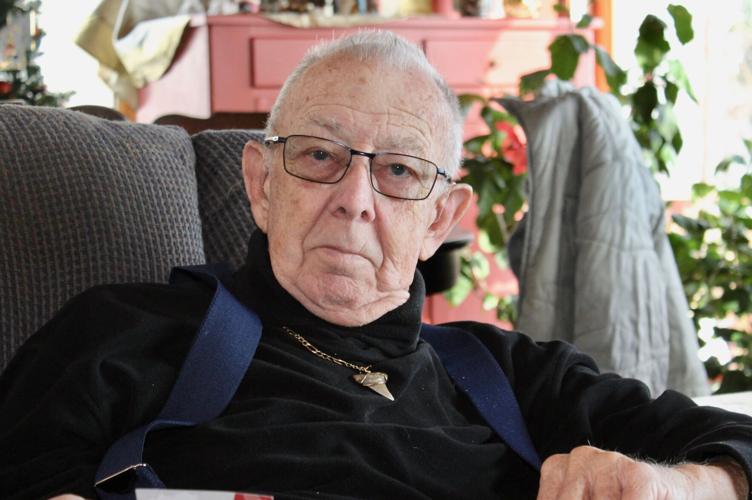
About two years before the iconic movie “Jaws” made the line popular, it was a Calvert County resident living on the Chesapeake Bay who observed that he was going to need “a bigger boat.”
Tom Ireland of Huntingtown recalled the early 1970s when the boat he owned at the time, an Anacapri, wasn’t large enough for commercial fishing. Although he was busy working as a trooper for the Maryland State Police and on his family’s farm, Ireland grew up on the waterways of Southern Maryland and having a boat that could handle passengers would be another ideal occupation.
Ireland said one day while hunting on the Eastern Shore with a friend he asked his fellow hunter if he knew of any boat builders. The friend told Ireland about Shannon Dawson, an Eastern Shore resident who built boats. Ireland contacted Dawson and a deal was struck.
“He promised to build it in 1974,” Ireland said, adding that he gave Dawson a deposit, which the builder then used to purchase the wood to be used for the boat’s construction.
However, fate intervened in 1973, as Dawson suffered two strokes, dying from the second.
Ireland was notified by Dawson’s widow that her husband had died. She asked if instead of returning his deposit, Ireland would accept the wood the boat was to be built with.
“I couldn’t say no,” Ireland said, adding that he had built a boat in high school, a 16-foot runabout.
The new boat would be a two-year project. Ireland said one of the bigger obstacles was transporting the wood from the Eastern Shore back to Calvert, which was done by way of trailer.
Ireland said it was his “Dutch uncle,” Lloyd Falk, a retired Navy veteran who was superintendent of maintenance for Calvert County Public Schools at the time, who assured him he would have his boat.
“We’ll build it,” Falk said, according to Ireland.
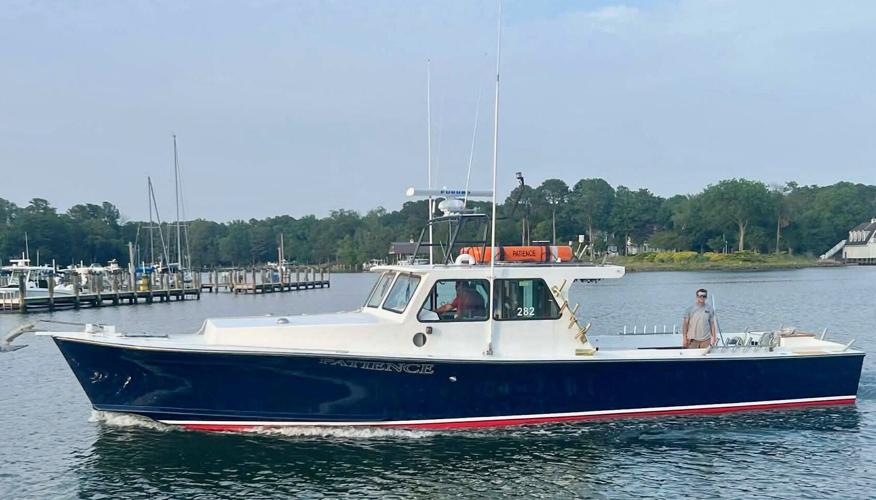
Ireland’s new vessel would be a Chesapeake Bay deadrise, a traditional fishing/work boat. The boat is built to tolerate the bay’s shallow, choppy waters.
Ireland told Southern Maryland News the wood for the boat was pine and there is documented information from a charter fishing publication that states juniper cedar from North Carolina served as planking for the boat’s hull.
Ireland, Falk and another man, Glen Corey from Rosehaven, built the vessel on Ireland’s property and launched it from there in 1975, pushing it down a hill and into the bay.
Ireland estimated his investment in the new boat was about $15,000.
“Tobacco money built that boat,” Ireland said of the 42-foot vessel, which he christened “Patience.”
In addition to charter fishing and bay tours, in 1988, one year prior to his retirement at the rank of sergeant from the Maryland State Police, Ireland was one of several boat operators who provided taxi service to and from Calvert and St. Mary’s counties when the Gov. Thomas Johnson Bridge was temporarily closed by the Maryland Department of Transportation due to concerns about the span’s structure.
It was after that temporary assignment that Ireland decided a major maintenance project on the boat was needed. To preserve the wood, the vessel was sanded down to accept a coating of what Ireland said is C-Flex glass, a type of fiberglass developed for boats.
The coating process took about three months and was done at a residence in Lusby.
Ireland said he doesn’t recall the exact cost of the coating project, but “it seemed reasonable at the time.”
Patience has had several engines, each more powerful than the previous one. Currently the boat sports two Cummins 6 Turbo Aftercoolers, with a total horsepower of 900.
At the height of the vessel’s time as a charter boat, the Patience and its crew averaged 150 to 170 trips a year. Ireland said business has slowed and the vessel ran “probably 60 [trips] this year.”
Maryland Department of Natural Resources has reduced fish maximum catch limits over the years.
“We don’t have the trout or the flounder anymore,” Ireland lamented. “We still have the bluefish, which saves us during the summer.”
While, overall, the charter boat industry on the Chesapeake Bay appears in decline, there are still fish to catch and summer cruises to take. Ireland said Patience’s clientele has always been and still is primarily from the Washington, D.C., and Baltimore areas, and even those who don’t wish to fish still love being out on the water.
“Some people just want to see the lighthouses,” Ireland said.