



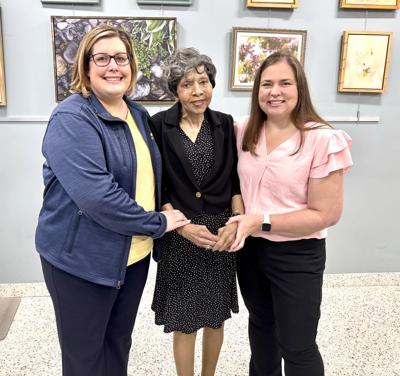
Gwendolyn Lowe’s strokes may have impacted her speech, but they haven’t stopped her from attending the stroke support group at MedStar St. Mary’s Hospital in Leonardtown.
Lowe, a Hollywood resident, started attending the support group after her second stroke in 2023.
“I never forget what I went through,” Lowe said. “We get to meet the people who had a stroke, and they understand how I feel.”
Ashley Holliday, clinical health educator at MedStar St. Mary’s Hospital, has managed the support group since 2021.
“I think it’s really important to have that community of people who had a stroke and then also the new people coming in,” Holliday said. “A lot of people really do like coming to the support group because it makes them feel like they’re not alone.”
May is Stroke Awareness Month, and along with hosting the support group, MedStar Health employees educate the community on stroke prevention and symptoms.
Strokes are the third leading cause of death in the United States and the leading cause of disability, Jennifer James, stroke program coordinator at MedStar St. Mary’s Hospital, said.
The acronym BE FAST, which stands for balance, eyes, face, arms or legs, speech and time, represents the various stroke symptoms. If an individual has trouble walking, seeing or speaking or experiences face drooping or weakness in their arms and legs, they may be having a stroke.
“It’s sudden onset. It could be one of these things. It could be multiple of these things depending on where in the brain the issue is occurring,” James said.
The last element, time, represents how quickly an individual needs care before their risk of disability or death increases.
“Time is tissue. Time is brain cells. Our goal is to treat you as soon as possible,” James said.
An ischemic stroke, which occurs when a blood clot cuts off circulation in the brain, can be improved with clot-busting medication up to four-and-a-half hours after symptoms began, James said.
“If we can get you in time … then if you think about somebody who has a pretty significant stroke and that they’re able to get the medication and their symptoms resolve immediately, wouldn’t you want that?” Holliday said. “It’s like a miracle drug in a sense.”
Individuals with diabetes, high cholesterol and high blood pressure are at a higher risk of experiencing a stroke, James said. Holliday suggests monitoring blood pressure and cholesterol. Losing weight and quitting smoking can lower an individual’s risk of stroke.
The age of stroke survivors has decreased, and more pregnant and postpartum women are having strokes, James said. The stroke program collaborates with MedStar Women’s Health to provide the community with the necessary information, including the BE FAST symptoms.
“We hear so many stories where patients start having symptoms and they’re like, ‘I’m just gonna lay down and take a nap’ … instead of getting help right away,” James said. “Sometimes strokes are very mild, but sometimes they’re devastating, and for someone to have to live with those deficits … it’s just horrible.”
Visit www.medstarhealth.org/services/stroke-rehabilitation to learn more about MedStar Health’s stroke program and the MedStar St. Mary’s Hospital’s stroke survivors support group.


