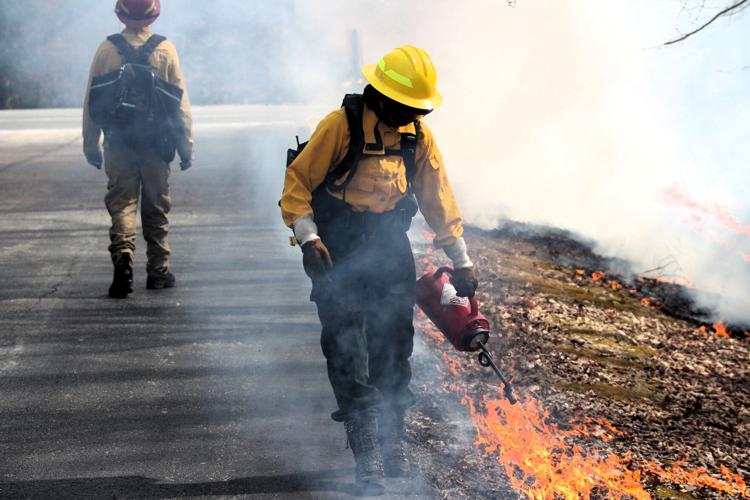
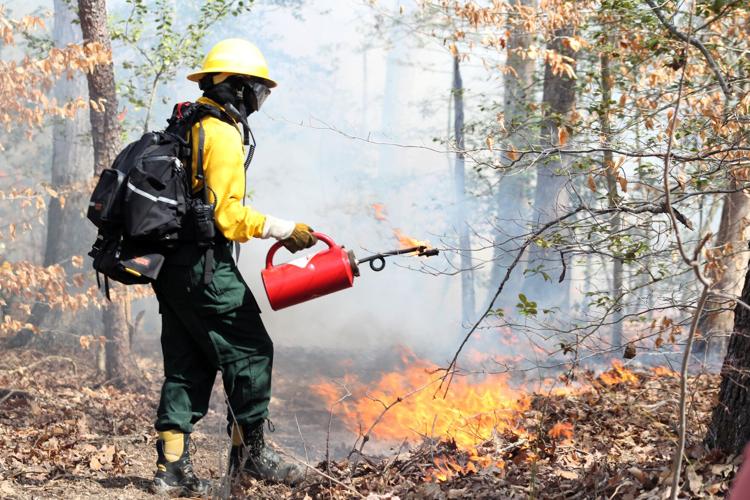
Risharda Harley walks down the entrance to the Nanjemoy Volunteer Fire Department on March 10 shortly after a test blaze was conducted, starting a controlled burn.
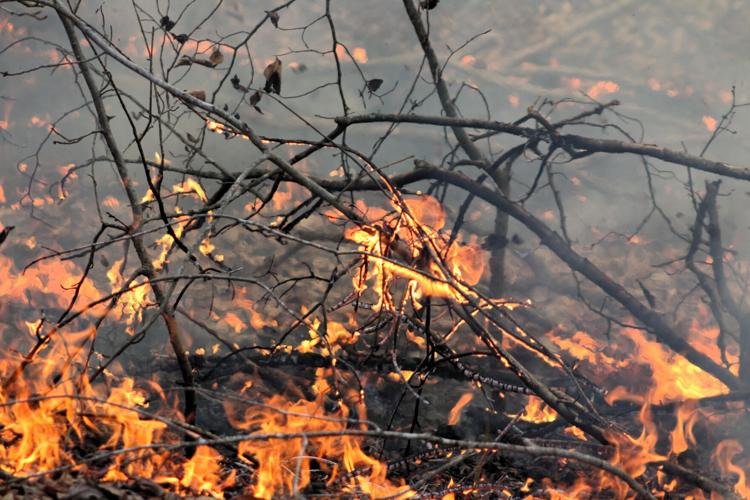
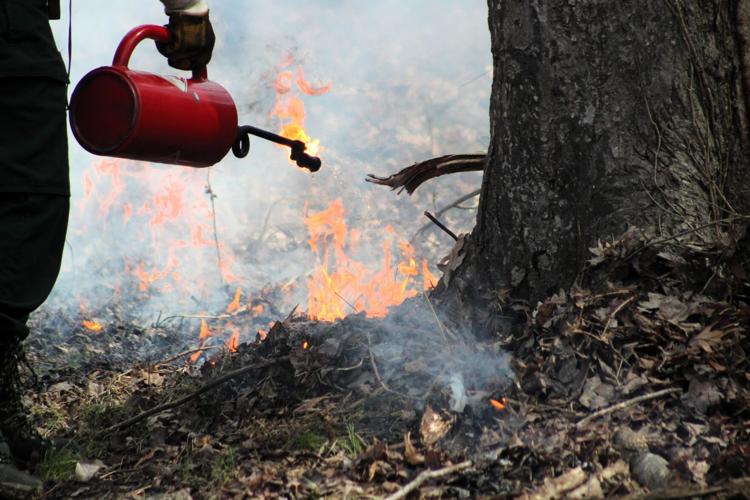
Fire begins to spread among small brush and leaves on the forest floor near the Nanjemoy Volunteer Fire Department during a controlled burn on March 10.
Risharda Harley walks down the entrance to the Nanjemoy Volunteer Fire Department on March 10 shortly after a test blaze was conducted, starting a controlled burn.
Matt Wynn/Southern Maryland News
Crews make their way along Beaver Dam Road, adjoining two fires around 1 p.m. on Monday, March 10.
Matt Wynn/Southern Maryland News
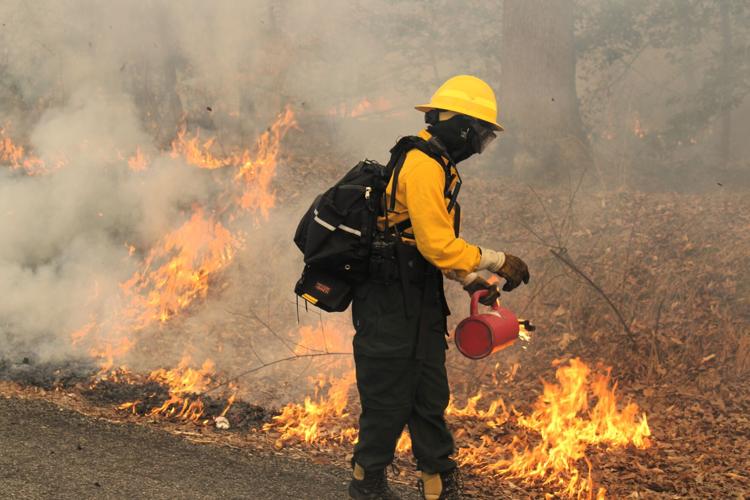
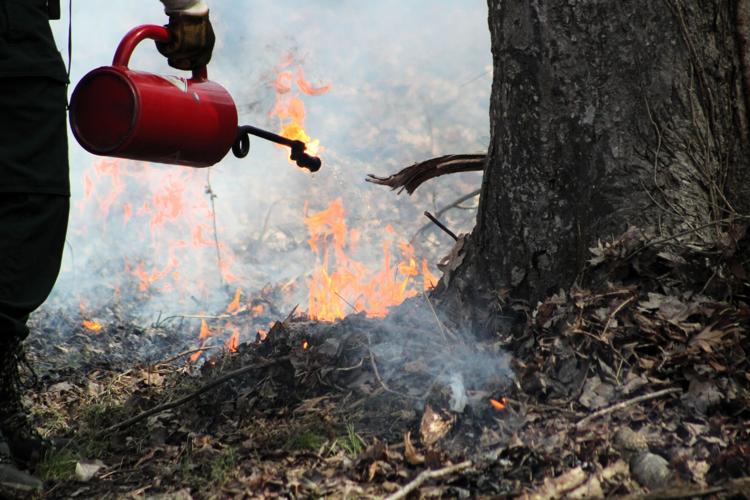
Drip torches were used to set fires to the forest floor in Nanjemoy in a controlled burn on March 10.
Matt Wynn/Southern Maryland News
Fire begins to spread among small brush and leaves on the forest floor near the Nanjemoy Volunteer Fire Department during a controlled burn on March 10.
Matt Wynn/Southern Maryland News
Crews worked in the brush between Beaver Dam Road and Port Tobacco Road, diligently spreading and containing the fire on March 10.
According to The Nature Conservancy, many native plants and animals across the state have evolved to withstand periodic episodes of natural fire.
Occasionally, in the absence of natural fire, it is necessary to artificially reintroduced to the land through various preservation agencies.
On March 10, a burn in Nanjemoy finally had the correct moisture and wind conditions to take place after being delayed since roughly November 2024.
The controlled burn at Nanjemoy Creek Preserve was conducted Monday to help a stand of native white oak trees by opening up the forest floor and providing more space for acorns to germinate. It will also provide nitrogen for the soil and promote the return of some native plant species, including wildflowers, members of The Nature Conservancy said.
“This will work out great,” Deborah Landau, director of ecological management at the conservancy, said before two concurrent burns took place. “A controlled burn is when we’re bringing fire back to the landscape.”
A controlled burn was conducted in Nanjemoy last year, but the process can be a bit complicated to get off the ground as there is a written, specified prescription for the land where strict conditions must be met.
“For myself, really I just try to focus and pay attention to the lead of the team,” Risharda Harley, one of the members in charge of ignitions that day from the Accokeek Foundation, said. “As I’m in there working, I try to take time to not have my head down and appreciate what’s going on.”
Micah Selengut, another igniter, said that he takes careful attention to look out for his team members and potential hazards.
“We’re here to bring back fire to the land, which hasn’t had fire in a really long time. It’s a huge deal,” Selengut said.
Gabe Cahalan, one of the chiefs in charge of the burn, said that usually smaller trees get killed and the mid-story of the forestry will be thinned.
“Thick bark trees are pretty fire resistant,” Cahalan said, addressing a group and answering their questions Monday morning. “Invasives can come back. … We do get a flush of wildflowers sometimes.”
Fire increases a forest’s biodiversity, making it more resilient. When a stand of trees includes many different species rather than a few, they are less likely to be wiped out by threats like pests or disease, according to the conservancy.
Crews from different organizations fly in from all over the country to participate in the burns, with some coming from North Carolina, Louisiana and as far as California.
On March 10, a controlled burn was held outside the Nanjemoy Volunteer Fire Department.
Matt Wynn/Southern Maryland News
Before any burning was done, crews swept parts of the forest floor with leafblowers to help keep the burn localized.
A test burn was conducted around 11:30 a.m., and when the conditions looked desirable, the real burn began.
Working along Port Tobacco Road directly outside the Nanjemoy Volunteer Fire Station, the crew worked its way to the intersection of Beaver Dam Road where they essentially burned a triangle between the two roads, carefully avoiding residences nearby.
Any hazards were quickly addressed by crews and a high-pressure hose.
Now, it’s a waiting game to see what will spring from the ash.