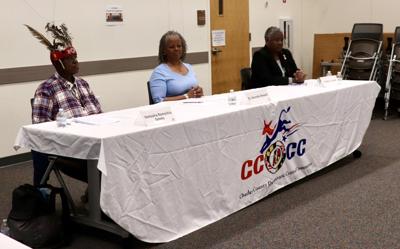
Candidates Vontasha R. Simms, left, Commissioner Amanda Stewart (D) and Dyotha R. Sweat speak during the Charles County Democratic Central Committee commissioner president forum at the Waldorf West Library on March 30.
Candidates Vontasha R. Simms, left, Commissioner Amanda Stewart (D) and Dyotha R. Sweat speak during the Charles County Democratic Central Committee commissioner president forum at the Waldorf West Library on March 30.
One of the notable similarities between the three Charles commissioner president candidates is that their last names start with “S.”
Another similarity the candidates had was their shared priority on education and Nicole Kreamer, chairperson for the Charles board of education, was glad to hear the candidates talk about the Blueprint for Maryland’s Future during the Charles County Democratic Central Committee forum on Monday at the Waldorf West Library.
“We know we’re in tough fiscal times,” she said. “We have to think creatively and innovatively to be able to fund our priorities when it comes to education.”
The county will need to make investments to meet the requirements of the Blueprint for Maryland’s Future, a law passed in 2021 that increases state funding for education for the next 10 years, Commissioner Amanda Stewart (D) said.
“You have to work collaboratively with [Charles County Public Schools] ensuring that you are funding their budget,” she said.
When a developer, contractor or investor comes to the county, funds should be reinvested through a private-public partnership to take the burden off of the school district, Vontasha R. Simms said.
Dyotha R. Sweat would like the county to incrementally change the commercial tax for larger businesses for the school district. There should also be a community partnership to increase grade level proficiency in the district.
“It’s not going to be a huge increase of funds that you will receive, but it will be some,” she said.
Differences that showed up included implementing term limits for commissioners and permitting for small businesses.
Stewart acknowledged the challenge of completing projects within a term limit. She suggested staggering term limits so “not everyone is coming off one at a time,” she said.
“When you talk about term limits, it doesn’t matter what side you’re on,” Stewart said. “There’s pros and cons with that topic.”
The comprehensive plan still gets implemented no matter who sits in the seat, Sweat said.
“Term limits allow integration and it allows fresh ideas,” Sweat said. “You know that you only have a certain amount of time to build your legacy.”
Term limits may be necessary for ineffective leadership, but would “hate to see our voters to be denied the opportunity … to have effective leaders,” Simms said.
While Simms said “no” to term limits, she would like to see campaign reform.
Small businesses should be given a checklist that tells them what they need to complete, Sweat said. Planning and growth management needs to fix what is not working and implement policies so people are “not afraid of the process.”
“Most of our small businesses do not have the revenue or the resources to sit idle for months at a time,” she said. “It should be user friendly and it is not in this moment.”
Simms would like to fix the roadblocks business owners run into and brought up having a livable wage in the county and suggested an oversight board for county departments to identify problems.
A lot of times when people hear concerns about the permitting process, it’s because people are coming to the process without the proper knowledge, Stewart said. There needs to be two “avenues” for people who are trying to build a shed and someone who is building a 100,000-square-foot space.
“It really depends on who you talk to,” Stewart said. “Not everyone has a good contractor or better engineer so seeing how we can do a better job to prepare is important.”
The process needs to be easier and less expensive, Natonya Thomas, general manager of The Shops at Waldorf Center, said.
“I want them to truly take them being open for business serious,” she said. “We have a lot of small businesses that open and close within a year or two because there’s no resources.”
Joe Crawford was nominated by the Charles County Republican Central Committee on March 2. He will face off against the Democratic winner of the June primary in November’s general election.